Overview
CJC-1295 is a synthetic analog of growth hormone releasing hormone (GHRH), the 29-amino-acid sequence engineered to resist the rapid enzymatic breakdown that limits native GHRH's activity. Two variants circulate in the research literature and supply trade — one incorporating Drug Affinity Complex (DAC) technology for substantially extended half-life, and a non-DAC variant closer to native GHRH's duration. Most contemporary research and product listings refer to the DAC-modified version unless otherwise specified.
What clinical trials have shown
CJC-1295's human evidence base is smaller and more complicated than the other GHRH-pathway compounds in this library, and it's worth understanding why.
The 2006 pharmacokinetic study
The foundational human data comes from a study by Teichman and colleagues, published in the Journal of Clinical Endocrinology and Metabolism — two randomized, placebo-controlled, ascending-dose trials in healthy adults. A single injection produced dose-dependent increases in growth hormone of roughly 2- to 10-fold, sustained for six days or more, and IGF-1 increases of roughly 1.5- to 3-fold, sustained for 9 to 11 days. With repeated dosing, IGF-1 levels stayed elevated above baseline for up to 28 days. No serious adverse reactions were reported in this trial.
Why development was discontinued
A separate Phase 2 trial tested CJC-1295 in HIV-associated visceral obesity (ClinicalTrials.gov NCT00267527). That trial was terminated in 2006 after a participant died of a heart attack; the attending physician attributed the death to pre-existing coronary disease rather than the study drug, but the sponsor, ConjuChem, halted the program as a precaution. CJC-1295 never advanced to Phase 3 trials or FDA review, and no further company-sponsored human trials have followed since. It remains, and is likely to remain, a research-use-only compound with no approval pathway currently active.
An honesty note on the "CJC-1295 + Ipamorelin" combination: this pairing is extremely widely discussed and sold as a stack, but there is no dedicated clinical trial of the combination itself. The commonly cited "synergy" is extrapolated from combining each compound's separate single-agent data — a reasonable mechanistic hypothesis, but not something that's actually been tested together in a controlled human trial.
Areas of investigation
- Sustained GH/IGF-1 elevation. The core research interest is CJC-1295's ability to produce a more sustained elevation in growth hormone and downstream IGF-1 levels than native GHRH, attributed to its resistance to enzymatic degradation.
- Combination studies with GHRPs. CJC-1295 is frequently studied alongside ghrelin-receptor agonists like ipamorelin, since GHRH analogs and GHRPs act on complementary parts of the growth hormone axis — see the Ipamorelin entry and the Science Hub.
- Pharmacokinetic comparison studies. A meaningful share of the literature focuses specifically on comparing the DAC and non-DAC variants' half-life and release profile.
What this doesn't mean: pharmacokinetic and hormone-release findings come primarily from animal studies. This entry summarizes what's being investigated about CJC-1295's mechanism, not a claim about outcomes in humans.
Molecular profile
External reference: CJC-1295 with DAC on PubChem (CID 91976842)
| Property | Value |
|---|---|
| Sequence class | 29-residue GHRH analog |
| Variants | DAC (extended half-life) and non-DAC forms |
| Receptor target | GHRH receptor |
| Solubility | Water-soluble; typically reconstituted with sterile or bacteriostatic water in lab settings |
Figures summarize commonly cited characteristics in the research literature and are provided for reference only — always consult the certificate of analysis (COA) for a specific research batch.
Handling & storage in a research setting
CJC-1295 follows standard lyophilized-peptide handling: frozen or refrigerated storage prior to reconstitution, protection from light and moisture, and limited freeze-thaw cycling once dissolved. See Protocols for general laboratory practices.
Research materials
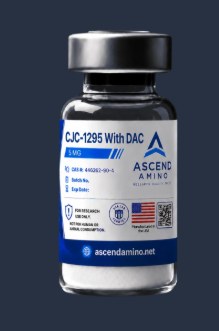
Batch-tested CJC-1295 for laboratory research use is available through Ascend Amino, including lot-specific certificates of analysis. Research use only — not for human or veterinary use.
Further reading
For background on this compound class, see Growth hormone secretagogues in the Science Hub, or compare against Ipamorelin, the GHRP most often studied alongside it.