Overview
Ipamorelin is a synthetic pentapeptide belonging to the growth hormone releasing peptide (GHRP) family. It acts on the ghrelin receptor (GHS-R), the same receptor targeted by the body's natural hunger-signaling hormone ghrelin. What distinguishes ipamorelin from earlier GHRP compounds in the research literature is its comparatively selective activity profile — studies frequently note that it stimulates growth hormone release with less pronounced effect on cortisol and prolactin than older-generation secretagogues.
What clinical trials have shown
Ipamorelin has one published human clinical trial to its name, and it's worth reading honestly rather than skipping over.
The postoperative ileus trial (2014)
Ipamorelin was tested in a Phase 2, placebo-controlled trial (Beck et al., published in the International Journal of Colorectal Disease) for postoperative ileus — the gut-motility slowdown that commonly follows bowel surgery. The rationale was that ghrelin-receptor agonism promotes gastrointestinal motility. 117 patients undergoing bowel resection were enrolled; ipamorelin was given as an IV infusion twice daily for up to seven days.
The result was a modest, statistically non-significant improvement: median time to tolerating a solid meal was 25.3 hours with ipamorelin versus 32.6 hours with placebo — a difference that didn't reach statistical significance in this study's size (p=0.15). Safety was favorable; adverse events were reported less often in the ipamorelin group than placebo (87.5% vs. 94.8%).
An honesty note: this is a proof-of-concept trial with a non-significant primary result, not a demonstration of efficacy — the program was not advanced further for this indication. It's genuinely useful safety and tolerability data, but it doesn't establish that ipamorelin does what it's most commonly discussed for (growth hormone optimization) in humans; the GH-release literature for ipamorelin remains largely preclinical. As with CJC-1295, no dedicated trial of the popular "CJC-1295 + Ipamorelin" combination exists — see the CJC-1295 entry for more on that.
Areas of investigation
- Pulsatile GH release. The core body of research examines ipamorelin's effect on growth hormone secretion patterns in animal models, often in comparison with other GHRPs.
- Receptor selectivity. A recurring research theme is characterizing how selectively ipamorelin activates GHS-R relative to other hormonal pathways, which is what differentiates it from earlier compounds in this class.
- Combination studies with GHRH analogs. Ipamorelin is frequently studied alongside GHRH analogs like CJC-1295, since the two act on complementary parts of the growth hormone axis — see the Science Hub for how this class is organized.
What this doesn't mean: selectivity findings come primarily from in-vitro receptor-binding assays and animal studies. This entry describes what's being studied about ipamorelin's mechanism, not a claim about outcomes in humans.
Molecular profile
External reference: Ipamorelin on PubChem (CID 9831659)
| Property | Value |
|---|---|
| Sequence class | Pentapeptide (5 residues) |
| Receptor target | Growth hormone secretagogue receptor (GHS-R / ghrelin receptor) |
| Solubility | Water-soluble; typically reconstituted with sterile or bacteriostatic water in lab settings |
| Stability notes | Standard short-peptide handling precautions apply — light-sensitive, hygroscopic in lyophilized form |
Figures summarize commonly cited characteristics in the research literature and are provided for reference only — always consult the certificate of analysis (COA) for a specific research batch.
Handling & storage in a research setting
Ipamorelin follows standard lyophilized-peptide handling: frozen or refrigerated storage prior to reconstitution, protection from light and moisture, and limited freeze-thaw cycling once dissolved. See Protocols for general laboratory practices.
Research materials
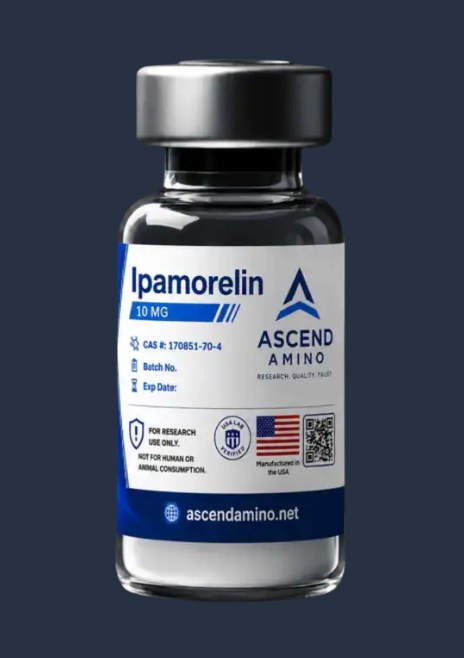
Batch-tested Ipamorelin for laboratory research use is available through Ascend Amino, including lot-specific certificates of analysis. Research use only — not for human or veterinary use.
Further reading
For background on this compound class, see Growth hormone secretagogues in the Science Hub. See also the Research Digest comparison, Ipamorelin vs. Tesamorelin.