Overview
Retatrutide is a synthetic peptide built on a GIP (glucose-dependent insulinotropic polypeptide) backbone, engineered to activate three receptors at once: GLP-1, GIP, and glucagon. That "triple agonist" design distinguishes it from single-target compounds like semaglutide (GLP-1 only), and is the central feature the research literature focuses on — the idea being that engaging the glucagon receptor alongside the incretin pathways may produce metabolic effects beyond what GLP-1 agonism alone achieves.
Important distinction: retatrutide is an investigational compound studied in clinical trials sponsored by its originating pharmaceutical developer. Research-grade material sold for laboratory use is a distinct product from any trial or pharmaceutical formulation, manufactured to different standards, and is not approved for human or veterinary use.
A note on evidence quality here: unlike most entries in this library, retatrutide has real published human clinical trial data behind it — see below. That's a meaningfully different evidence base than the mostly preclinical/animal-model literature that applies to most compounds this site catalogues.
What clinical trials have shown so far
Retatrutide has advanced further into human clinical development than almost any other compound catalogued on this site, sponsored by its originating pharmaceutical developer, Eli Lilly. As of this entry's last review, four separate trial readouts have been reported.
Phase 2 trial (2023)
The foundational trial, published in the New England Journal of Medicine, was a 48-week, placebo-controlled study testing four dose levels in adults with obesity or overweight. Weight loss was clearly dose-dependent: the highest tested dose produced a mean reduction of roughly 24% of body weight by week 48, compared to about 2% in the placebo group. Notably, the trial noted that weight loss had not yet plateaued by week 48, meaning the full effect of the drug likely wasn't captured within the study window. A related substudy in participants with elevated liver fat found substantial reductions in liver fat content at the higher doses, with most of those participants reaching a normal liver-fat range by 24 weeks.
Phase 3 TRIUMPH program (2025–2026)
Retatrutide's Phase 3 program, called TRIUMPH, has since reported several results. TRIUMPH-4, the first successful Phase 3 readout (December 2025), found roughly 28.7% average weight loss at 68 weeks in a population also being studied for knee osteoarthritis. TRIUMPH-1, the pivotal general-obesity trial (May 2026, over 2,300 participants), reported around 28.3% weight loss at 80 weeks, extending to roughly 30% at 104 weeks — results researchers have compared to outcomes typically associated with bariatric surgery. A separate three-trial program specifically in type 2 diabetes, TRANSCEND, reported its first readout in mid-2026: roughly a 2-point reduction in HbA1c alongside meaningful weight loss in participants with type 2 diabetes.
Safety findings reported across trials
The most consistently reported side effects across the trial program have been gastrointestinal — nausea, vomiting, and diarrhea — generally described as mild-to-moderate and concentrated in the dose-escalation period, a pattern broadly similar to other incretin-pathway compounds like GLP-1 agonists. The Phase 3 program has also reported dose-dependent discontinuation rates and some signal around nerve-related sensory symptoms and urinary tract infections at higher doses, which trial investigators continue to monitor.
What this data does and doesn't tell you: these results come from a supervised clinical trial — controlled dosing, escalation schedules, and safety monitoring by trial physicians. This says nothing about the safety, purity, or effects of research-grade material used outside that context. As of this entry's last review, retatrutide remains unapproved by the FDA for any indication; its developer has indicated plans to file for approval in early 2027, with a possible approval and launch sometime in 2027–2028 if trials continue to succeed. Timelines like this shift often and shouldn't be treated as guaranteed.
Areas of investigation
- Multi-receptor metabolic signaling. The bulk of the mechanistic literature examines how combined GLP-1/GIP/glucagon receptor activation affects glucose regulation, lipid metabolism, and energy expenditure relative to single- or dual-agonist compounds.
- Comparative incretin research. Retatrutide is frequently studied alongside GLP-1-only and GLP-1/GIP dual-agonist compounds as a reference point for how additional glucagon receptor activity changes the metabolic profile.
- Energy expenditure pathways. Because glucagon receptor agonism is linked to increased energy expenditure in animal models, this is a recurring theme distinguishing retatrutide-focused mechanistic research from single-target incretin literature.
What this doesn't mean: even with real human trial data available, the results above describe a specific pharmaceutical formulation under supervised clinical conditions in defined patient populations. They don't describe, and shouldn't be read as guidance about, research-grade material used outside that context.
Molecular profile
External reference: Retatrutide on PubChem (CID 171390338)
| Property | Value |
|---|---|
| Sequence class | Modified GIP-based peptide |
| Receptor targets | GLP-1, GIP, and glucagon receptors (triple agonist) |
| Solubility | Water-soluble; typically reconstituted with sterile or bacteriostatic water in lab settings |
| Stability notes | Structural modifications are associated with extended half-life relative to native incretin peptides, consistent with other compounds in this class |
Figures summarize commonly cited characteristics in the research literature and are provided for reference only — always consult the certificate of analysis (COA) for a specific research batch.
Handling & storage in a research setting
Retatrutide follows standard lyophilized-peptide handling: frozen or refrigerated storage prior to reconstitution, protection from light and moisture, and limited freeze-thaw cycling once dissolved. See Protocols for general laboratory practices.
Research materials
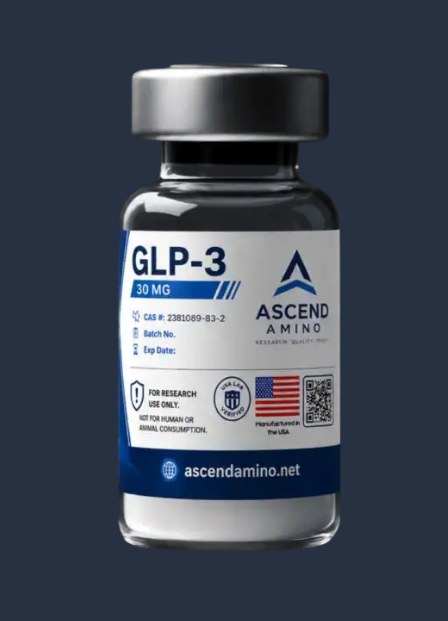
Batch-tested retatrutide for laboratory research use is available through Ascend Amino, including lot-specific certificates of analysis. Research use only — not for human or veterinary use.
Further reading
For background on this compound class, see Metabolic and appetite-signaling peptides in the Science Hub, or compare against Semaglutide, the single-target GLP-1 agonist most often used as a reference point in this literature.