Overview
Tesamorelin is a synthetic analog of the full 44-amino-acid growth hormone releasing hormone (GHRH) sequence, chemically stabilized to resist rapid enzymatic degradation. Unlike most compounds in this library, tesamorelin has also been developed into an approved pharmaceutical (marketed as Egrifta) for a specific clinical indication — HIV-associated lipodystrophy — which means there's a larger body of human clinical literature available for this compound than for most others catalogued here.
Important distinction: research-grade tesamorelin sold for laboratory use is a distinct product from the approved pharmaceutical formulation, manufactured to different standards. The existence of an approved indication for the branded product does not extend to research-grade material, which is not for human or veterinary use.
What clinical trials have shown
Tesamorelin is FDA-approved — the only GHRH analog in this library with that status — based on two pivotal Phase III trials in HIV-associated lipodystrophy involving a combined 806 participants.
Pivotal Phase III trials
Across a pooled analysis of both trials, tesamorelin (2 mg daily) reduced visceral adipose tissue by approximately 15% relative to placebo over 26 weeks, alongside reductions in fasting triglycerides. The reduction in visceral fat was maintained through 52 weeks in patients who continued treatment, but visceral fat reaccumulated after discontinuation — indicating, similarly to semaglutide, that the effect depends on continued use. Serious treatment-related adverse events occurred in under 4% of patients during the initial 26-week period.
Later meta-analysis and expanded findings
A more recent meta-analysis pooling five randomized controlled trials confirmed the visceral fat and trunk fat reductions, and additionally found modest increases in lean body mass alongside reductions in liver fat — with no worsening of glucose or lipid parameters, addressing an early concern about GHRH analogs and insulin sensitivity. Separate post-hoc analyses have also found tesamorelin's efficacy holds regardless of dorsocervical fat presence (a specific fat-redistribution pattern), and that it reduces visceral and liver fat even in patients on newer antiretroviral regimens associated with weight gain.
What this data does and doesn't tell you: tesamorelin's approval (as Egrifta / Egrifta SV, first granted in 2010) covers a specific indication — HIV-associated lipodystrophy — under physician supervision and a specific dosing regimen. It says nothing about the safety, purity, or effects of research-grade material used outside that regulated, indication-specific context, and an approval for one population doesn't imply safety or efficacy for other uses.
Areas of investigation
- Visceral fat and lipid metabolism. The bulk of the clinical literature examines tesamorelin's effect on visceral adipose tissue, the research basis for its approved indication.
- GH/IGF-1 axis restoration. Preclinical work continues to study tesamorelin as a tool for restoring more naturalistic, pulsatile growth hormone release patterns.
- Cognitive and neurological research. A smaller body of literature has explored GHRH signaling's relationship to cognitive markers in aging models, an active but earlier-stage research direction.
What this doesn't mean: tesamorelin's approved-indication data applies specifically to the branded pharmaceutical product, studied populations, and delivery method. It does not transfer to research-grade material used outside that regulated context.
Molecular profile
External reference: Tesamorelin on PubChem (CID 16137828)
| Property | Value |
|---|---|
| Sequence class | 44-residue GHRH analog |
| Receptor target | GHRH receptor |
| Solubility | Water-soluble; typically reconstituted with sterile or bacteriostatic water in lab settings |
| Stability notes | Structural modifications extend half-life relative to native GHRH, a recurring theme across this compound class |
Figures summarize commonly cited characteristics in the research literature and are provided for reference only — always consult the certificate of analysis (COA) for a specific research batch.
Handling & storage in a research setting
Tesamorelin follows standard lyophilized-peptide handling: frozen or refrigerated storage prior to reconstitution, protection from light and moisture, and limited freeze-thaw cycling once dissolved. See Protocols for general laboratory practices.
Research materials
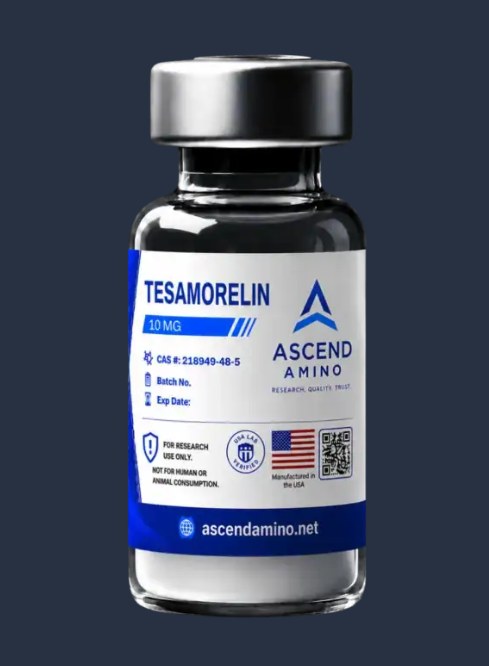
Batch-tested tesamorelin for laboratory research use is available through Ascend Amino, including lot-specific certificates of analysis. Research use only — not for human or veterinary use.
Further reading
For background on this compound class, see Growth hormone secretagogues in the Science Hub, or compare against CJC-1295, the other GHRH analog in this library. See also the Research Digest comparison, Ipamorelin vs. Tesamorelin.