Overview
GLOW is a blend name used across the research peptide trade for a combination formulation, most commonly built from GHK-Cu, BPC-157, and TB-500. The rationale for combining them is that each is independently studied in tissue-repair and dermal-research literature, with proposed complementary mechanisms — GHK-Cu's association with collagen synthesis, BPC-157's gastroprotective and angiogenic research profile, and TB-500's actin-regulation and cell-migration research.
A note on blend naming: "GLOW" is a trade-common name, not a standardized formulation — exact ratios and included peptides can vary between suppliers and even between batches. Always check the specific certificate of analysis (COA) for a given lot rather than assuming a fixed composition from the name alone.
Areas of investigation
- Combined tissue-repair pathways. Because the individual components target overlapping but distinct mechanisms (angiogenesis, actin regulation, collagen synthesis), blend-level research interest centers on whether combined administration produces effects beyond any single compound.
- Dermal and connective-tissue research. The blend is frequently referenced in the context of skin and connective-tissue research, drawing primarily on GHK-Cu's individual literature base.
What this doesn't mean: the research literature on individual components (GHK-Cu, BPC-157, TB-500) is considerably more developed than literature on this specific combination. Most of what's known about "why" this blend is used comes from extrapolating each peptide's individual research profile, not from studies of the combination itself.
Molecular profile
External references: GHK-Cu (CID 71587328) · BPC-157 (CID 9941957) · TB-500 parent protein (CID 45382195) on PubChem
| Property | Value |
|---|---|
| Composition | Combination of GHK-Cu, BPC-157, and TB-500 (see individual entries for each) |
| Solubility | Water-soluble; typically reconstituted with sterile or bacteriostatic water in lab settings |
| Stability notes | Follows the most conservative handling requirements among its component peptides |
Blend composition and ratios vary by supplier and lot — always consult the certificate of analysis (COA) for a specific research batch rather than relying on the figures above.
Handling & storage in a research setting
Multi-peptide blends follow the same general lyophilized-peptide handling as single compounds — frozen or refrigerated storage prior to reconstitution, protection from light and moisture, and limited freeze-thaw cycling once dissolved. See Protocols for general laboratory practices.
Research materials
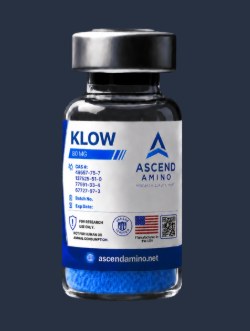
Batch-tested GLOW Blend for laboratory research use is available through Ascend Amino, including lot-specific certificates of analysis. Research use only — not for human or veterinary use.
Further reading
For the individual research profiles behind this blend, see GHK-Cu, BPC-157, and TB-500. See also the KLOW Blend entry for a related combination.